

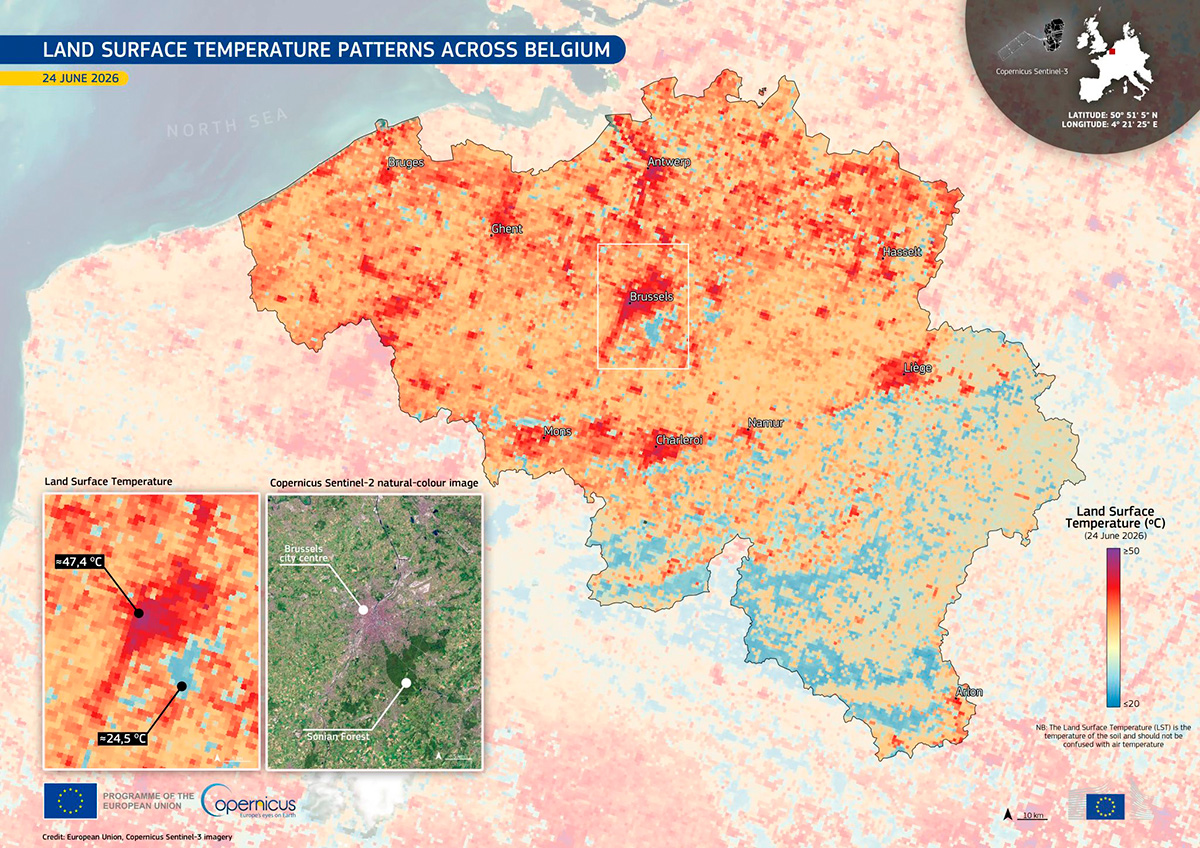
The European Environment Agency (EEA) has published a dashboard cross-referencing the 2021 European census (Eurostat) with urban heat island (UHI) intensity modelling carried out by VITO for the Copernicus Climate Change Service. The UHI phenomenon refers to the more pronounced warming of certain urban areas, linked to building density, soil sealing and a lack of vegetation, compared with more vegetated areas. The analysis reveals highly uneven exposure across cities: in Malaga, Genoa and Athens, almost the entire population lives in UHI-affected areas, while in absolute terms, Paris, Athens and Barcelona have the largest number of residents affected. Certain demographic groups are overrepresented depending on the city: older people in Porto, Pécs and Venice, residents born outside the EU in Barcelona, Brussels and Berlin, and people not in employment in Brussels, Liège and Porto.
As a local illustration, Copernicus Sentinel-3 data from 24 June 2026, recorded during a national heatwave alert, measured a land surface temperature gap of nearly 23°C between Brussels city centre (exceeding 47°C) and the nearby forest canopy of the Sonian Forest (24.5°C).
For forest and natural area managers, these findings support the case for green infrastructure as a lever for climate adaptation and public health, with the EEA advocating sustained investment in greening efforts targeted at the most vulnerable populations.