

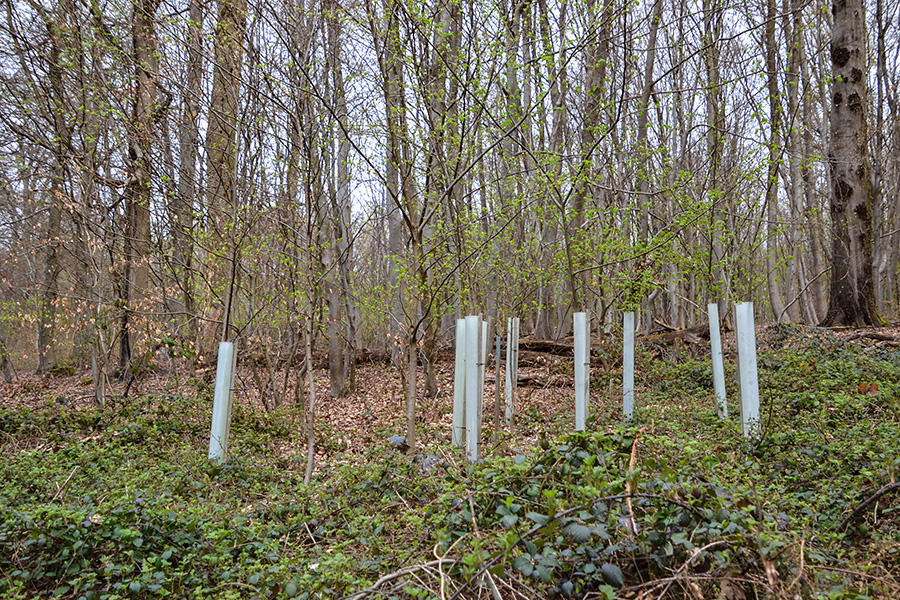
Planting young seedlings in dense, evenly spaced groups across a stand: this is the technique known as cluster planting, or nest planting (Nesterpflanzung in German), a method that is increasingly attracting the interest of forest managers and private forest owners. It offers an alternative to full planting, being more economically advantageous, more resilient in the face of climatic variability, and conducive to forest diversification.
Particularly well suited to stands requiring reforestation or following a clearcut, cluster planting involves grouping young seedlings into dense « nests » (from 5 to 25 seedlings per nest, spaced 0.7 to 2 metres apart, sometimes more in the most selective configurations). The individual trees, compelled to cohabit in close proximity with their neighbours, self-train and self-prune, thereby promoting competition and natural selection among individuals. The nests are spaced 10 to 20 metres apart across the stand. Over one hectare, approximately twenty nests ranging from 4 to 50 m² are typically established, with a planting density within these clusters that can reach 14,000 seedlings. The wide spacing between nests, meanwhile, allows the free development of natural regeneration and spontaneous diversity, opening the way for intermediate yield.
Beyond its benefits for forest diversity, cluster planting offers an economic advantage and simplifies stand management, as presented in issue 687 of “Forêts de France”. The production of quality timber species such as oak and beech is favoured, potentially supplemented by other species such as hornbeam, birch, or black locust. Without precluding rigorous silvicultural monitoring, this method allows for simplified and reduced stand management: the concentration of seedlings and the natural competition between individuals reduce both the area requiring preparation and the maintenance work within the clusters. The result: preparation and maintenance costs per hectare are reduced by a factor of three compared to conventional full planting (less than €1,700 excluding VAT for 25 groups of 13 oak trees in 9-metre plots, versus approximately €4,800 excluding VAT for full planting).