

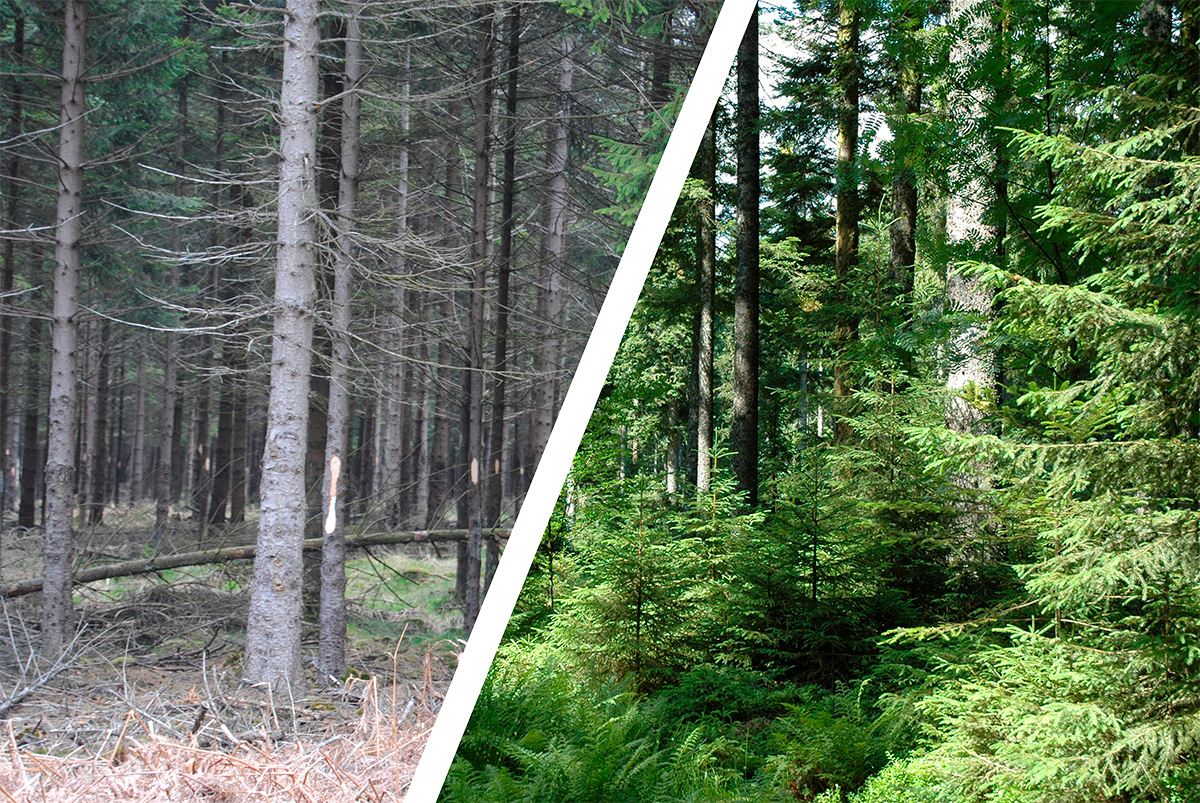
Choosing whether to maintain an even-aged structure or to progressively irregularize it by adopting continuous cover management is a major challenge for forest management in the context of climate change.
This study compares these two approaches based on their effects on production, profitability, carbon storage, ecosystem functioning, biodiversity, and resistance to disturbances. The development of fifteen representative stands in forests located in Wallonia, initially even-aged and close to maturity, was simulated under these two strategies. Both rely on natural regeneration. On one hand, the stand is renewed all at once through the shelterwood system; on the other, continuous cover is maintained and the stand is progressively regenerated in the understory while being harvested regularly. The results show that both even-aged and uneven-aged management achieve broadly similar economic performance and carbon storage over the course of a rotation. The carbon balance is positive in all stands and roughly four times higher in conifers, owing in particular to greater accumulation of living biomass, increased storage in harvested wood products, and above all a larger substitution effect. In broadleaf stands, the carbon balance is on average 18% higher under uneven-aged management, mainly in oak stands and oak–beech mixed stands.
Ecosystem functioning remains fairly similar between the two approaches. However, uneven-aged stands show significantly greater temporal stability, particularly among conifers. This stability appears to be more closely linked to the basal area and growing stock levels set for the simulation than to the silvicultural structure itself. Biodiversity outcomes are mixed: tree species diversity tends to be higher under even-aged management, whereas trees bearing tree microhabitats (dendromicrohabitats) are generally more abundant under uneven-aged management. Finally, uneven-aged silviculture markedly improves resistance to wind by avoiding the periods of high vulnerability characteristic of mature even-aged stands.
The results of this study show that the choice of the most appropriate silvicultural system depends on what factors are prioritized. Uneven-aged management offers an advantage in terms of stability, management risk, and the presence of tree microhabitats.