

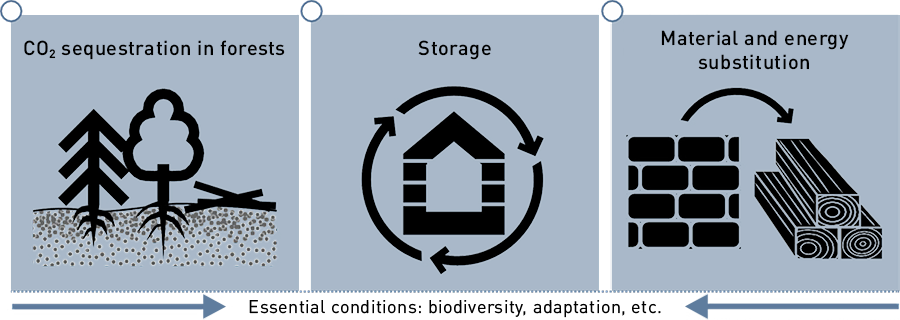
In Switzerland, the Federal Office for the Environment (OFEV) compiles an annual greenhouse gas balance sheet. For forests, it takes into account the famous three S’s: CO₂ Sequestration, carbon Storage in wood products, and material and energy Substitution.
In this regard, the vitality and biodiversity of the forest ecosystem are fundamental to its functionality and resilience. Adaptive, nature-based forestry combined with the thoughtful use of wood for various material and energy purposes can thus enhance the climate services provided by forests and wood.
Under international climate agreements, Switzerland has committed to achieving net zero emissions by 2050 and must report annually on this in its national inventory.
Forest sequestration corresponds to the net CO₂ balance of the ecosystem. Forests are carbon sinks when they absorb more CO₂ than they emit. To maintain a positive balance, taking silvicultural measures to adapt to climate change is essential.
For carbon storage in wood products, only products made from wood harvested in Switzerland are taken into account.
Under the Kyoto Protocol, it is possible to achieve its objectives by resorting to other agricultural activities that capture CO₂ from the atmosphere, but Switzerland has chosen to rely solely on forest management and wood products to meet its commitments.
In a study on the climate benefits of forest management and wood use in Switzerland, the OFEV found that:
- The greatest contribution can be made by changes in forest management. Forests should be adapted as much as possible to the current and future climate through adaptive, nature-based forestry.
- Substitution effects are limited in time. They will decrease in the future, and the current window of opportunity must be exploited.
- Cascading wood use improves overall climate performance. Therefore, wood should only be used for energy recovery after it has been used several times in the manufacture of long-lasting wood products.
- Performance depends heavily on the reference framework and accounting method.
The study provides a solid basis for the development of forestry and timber policy in Switzerland, and its conclusions have been incorporated into the Comprehensive Strategy for Forestry and Timber 2050.