

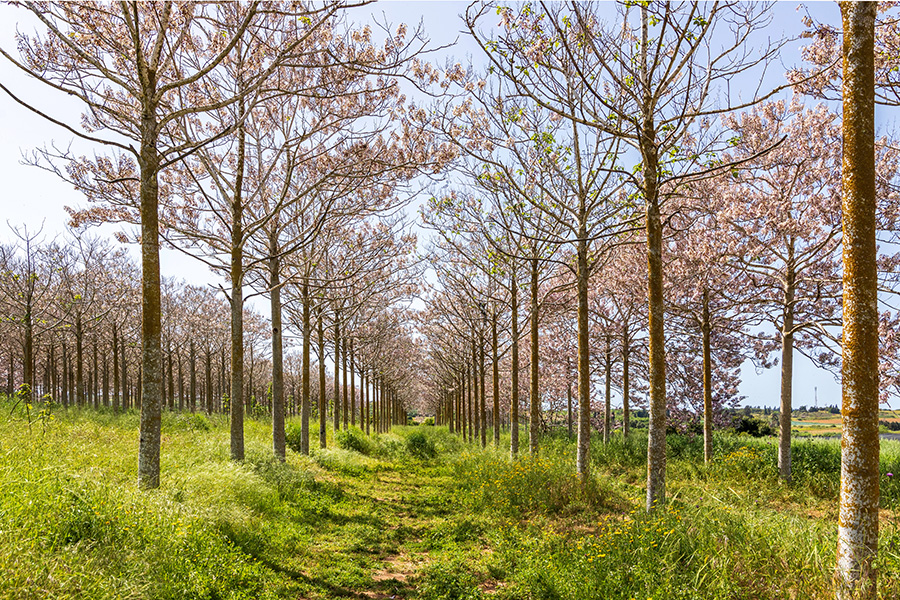
Paulownia is an Asia native species (mainly China) introduced to Europe in 1834 for its spectacular spring blossoms and ornamental use in parks and gardens.
In France, some companies are now promoting it for the quality of its wood – renowned for being very light and easy to work with – as well as for its promise of very high productivity, enabling a short production cycle and a return on investment in just under 10 years. Impressive timber yields, potentially reaching 44 m³/ha/year for the best clones in hyper-intensive systems, have been reported abroad. However, the report on this subject in the journal Forêt & Innovation (IDF) warns that this high level of productivity has not yet been confirmed by scientific publications in France. Furthermore, these values can only be achieved by following rigorous technical procedures on very favourable soils. Paulownia is a demanding species which requires careful planting, very good light exposure and, in most cases, regular watering (irrigation) during the first few years to establish itself. Productivity drops considerably in the event of water stress or on degraded soils.
There are major health risks. Numerous pests (defoliating insects, wood-boring insects, biting-sucking insects) and pathogens have been reported.
In France, the legal status of paulownia as a forest species is unclear (it is still not on the official list of forest reproductive material) and plantations on agricultural land with densities greater than 100 stems/ha may not be eligible for CAP compensatory aid. Furthermore, although it is popular in Asia, a stable market price is still far from being established in France given the limited volumes currently available.