

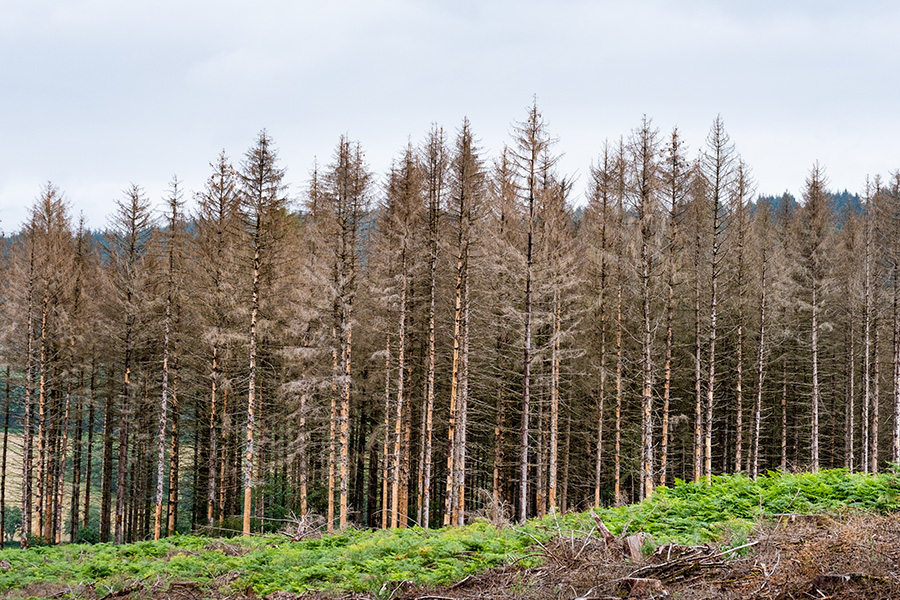
An international study, coordinated by the Technische Universität München (TUM), delivers for the first time a continental-scale projection of major forest disturbances to 2100: fires, storms, and bark beetles.
The findings are unambiguous: under the most pessimistic scenario (warming of +4 °C), the European forest area affected could more than double by the end of the century. Even under the most favourable scenario (+2 °C), disturbance levels would exceed those recorded during the reference period 1986-2020, which already represented a historically elevated phase.
The model is built on an artificial intelligence architecture trained on 135 million data points derived from forest simulations covering 13,000 European sites, coupled with multi-decadal satellite time series. This approach enables a spatial resolution of one hectare and reveals significant regional disparities: forests in southern and western Europe will be the most exposed, while northern Europe, broadly less affected, will nonetheless see localised hotspots of intensification emerge.
Yet the authors refuse to reduce these projections to a simple accounting of losses. Disturbances also act as catalysts for silvicultural transformation. By opening the canopy, releasing space, and resetting stand dynamics, they create windows of opportunity for establishing tree species and forest structures better suited to future climatic conditions. Forestry is thus called upon to move beyond a purely defensive logic and adopt a proactive stance: guiding these forced renewals, steering regeneration, and designing the resilient forests of tomorrow from the present day.