

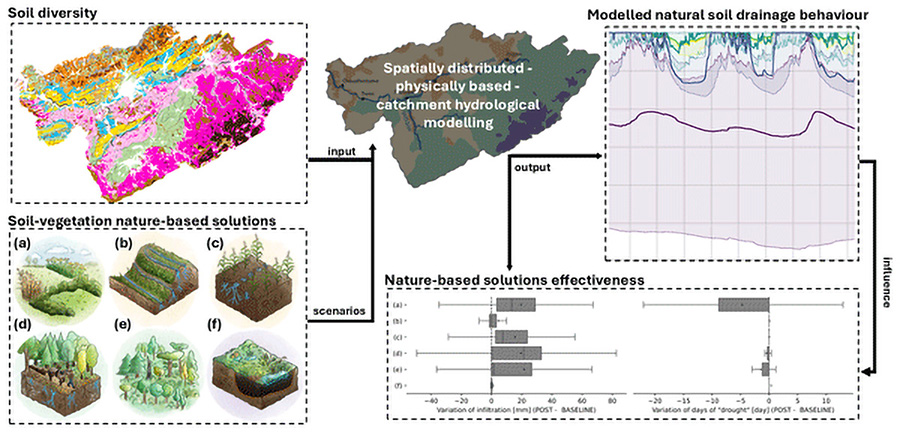
This study examines how soil diversity shapes the effectiveness of nature-based solutions (NbSs) designed to mitigate floods and agricultural droughts in productive catchments.
Standard modelling approaches often overlook local soil–water interactions, so the authors use a complete hydrological model that simulates infiltration, evapotranspiration and runoff using spatial data such as soil properties, topography and vegetation.
Two contrasting catchments were analysed: an agricultural basin with hedgerows, reduced tillage and soil pitting, and a forested basin with forest diversification, reduced soil compaction and peatland restoration. NbS performance was evaluated through spatial indicators of flood reduction and drought mitigation.
The model accurately reproduced discharge and saturated zone dynamics, highlighting the central role of natural soil drainage. In well-drained soils, hedgerows and other NbSs significantly improved infiltration, enhanced hydraulic properties and increased evapotranspiration, resulting in clear benefits for both flood and drought mitigation. In waterlogged soils, improvements were modest, revealing limits to NbS effectiveness in poorly drained environments. Well-drained soils also provided co-benefits for drought reduction, as NbSs help alleviate their higher susceptibility to water deficits.
The study stresses the need to account for spatial variability when planning NbSs and identifies key knowledge gaps, including the need for more spatially resolved data and better uncertainty analyses.